Showing posts with label Panther Ring. Show all posts

Tuesday, March 13, 2012

RAGTIME: A JEWELER'S TIN PAN ALLEY CAT


"Peg O'My Heart" featured in The Ziegfeld Follies 
 (Image from NYPL Digital Gallery)

Penciled into Gustav's stockbook is a name matching that of the originator of such toe-tapping tunes as "Chicago, That Toddlin' Town..." (1922), torchy songs like "I'd Rather Be Blue" and "My Man" (1928, with Billy Rose), and kitsch like "Peg O'My Heart" (1913)—which probably rivaled Lawrence Welk in its symphonic Aeolian player organ song-roll form. 

Fred Fischer, the composer of these and other songbook standards, was born in 1875 to American parents based in Cologne, Germany. His father, Max Fischer, was a traveling glove salesman, while his mother, Theodora von Breitenbach, was a writer and journalist involved with the Baron Von Hirsch Institute. Fred ran away from home at 13 and joined the Prussian Navy, served in the French Foreign legion, and worked as a traveling salesman in India and the U.S., before emigrating to America in the early 1900s. He started his songwriting career while working for a Chicago music publisher, went on to became a Tin Pan Alley fixture, then—when radio cut into demand for sheet music—got his second wind in Hollywood writing for silent films and Ziegfeld-esque musical reviews (one of them, "A Tableau of Jewels," featured an exotic dancer in pasties emerging from her art-deco shell...) before moving back to New York. 


Fred Fischer aspired to write serious music but found greater success composing music for Vaudeville stars such as Blossom Seeley known as the Queen of Syncopation

On the 30th of December 1915, Fischer was on the cusp of 40; his wife had just given birth to their first child, Doris. Professionally he'd had a strong year, with a new hit entitled "Siam." Prone to bouts of melancholy, Fischer (who would eventually drop the "c" in his name, probably to make it seem less Germanic) may have needed cheering up before New Year's Eve revels and stopped by Gustav Manz's workshop (then located a few blocks east of Tin Pan Alley, at 37 E 28th Street) where he purchased one of Manz's signature rings—a gold panther crouched over a topaz in a leafy setting. 


Gustav Manz ledger records a Panther and Topaz ring 
sold to Fred Fischer (Winterthur Museum archive);
below, Manz's model for a panther and snake ring, circa 1910-20 (private collection; photo by Ellen Martin for Gustav Manz LLC


Following her dad's path, Doris Fischer grew up to become a popular radio singer-songwriter—her first hit was "Tutti Frutti"; "You Always Hurt the One You Love" became a million-seller for the crooning Mills brothers. After marrying she retired from showbiz and took up a second career as an interior designer, helping First Lady Jacqueline Kennedy locate period pieces for her White House makeover. Doris's brothers, Dan and Marvin, who took over their father's music publishing business, wrote such jazzy standards as "Good Morning Heartache" (Dan), and "When Sunny Gets Blue" (Marvin).


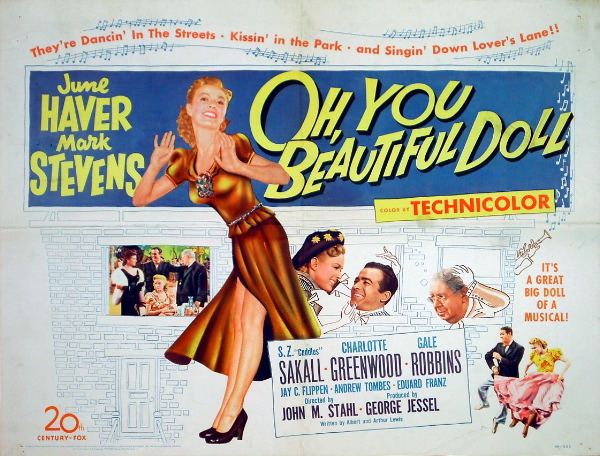
According to the New York Times, Fred Fischer wrote or published a thousand songs. Paramount produced a musical "Oh, You Beautiful Doll" based on his life story (though the title song was written by Irving Berlin)

As for Fred, Billboard's March 1949 Honor Roll of Popular Songwriters noted that he never lost his thick German accent, was a rabid baseball fan and rooter of the Yankees, and had a standing offer of $50 for anyone who could make him laugh. Incredibly prolific, he even wrote his own swan song (plagued by ill health, he committed suicide in January 1942). The chorus ran: "In my ranch 'way up in heaven, with the old gang around/Just the promised land for an old cowhand in my happy huntin' ground..." (More details on this lyrical American family here and here.)

Doris Fisher (photo: San Francisco Jazz Organization

recorded by Billy Murray in Camden, NJ on September 5, 1916
http://www.loc.gov/jukebox/recordings/detail/id/5140/

Copyright © 2014 
All Rights Reserved 
 GUSTAV MANZ LLC


Postscript March 2021: 

Further research turned up a possible alternative identity for the circa 1915 purchaser of Manz's panther and topaz ring: A diamond setter named Fred Fischer worked for the Newark firm of Sloan & Co. and would likely have been familiar with Manz's work for Tiffany & Co and other jewelry retailers of that era. 

—The Editors


Wednesday, January 18, 2012

LOOK BOOK: HOW TO SPOT JEWELRY BY GUSTAV MANZ


ASJH NEWSLETTER, SUMMER 2011

On April 7, 2011, The American Society of Jewelry Historians invited Courtney Bowers-Marhev to speak to members about the jewelry of Gustav Manz, whose work she first encountered as a graduate student in Parsons-Cooper Hewitt's Masters Program in the History of Decorative Arts. Estate jewelry expert Diana Singer subsequently provided highlights from Bowers-Marhev's slideshow in the ASJH summer newsletter, along with some tips for Manz spotting:

"....It is important to note that, in those days—unlike today, where the designer/manufacturer often aggressively courts and markets directly to the consumer—it was unthinkable for the skilled wholesaler to directly approach the retail client unless specifically invited to do so. Prominent retail stores such as those previously named often sold pieces made by Gustav Manz, and marked them as their own works. Only someone familiar with his inimitable style would have any idea he was the genius responsible for the jewel, and not the retail establishment. What, then, are the characteristics of Gustav Manz's style, and how does the trained eye recognize it? The roots of Manz's style lay firmly in the Art Nouveau movement, replete with animal motifs, valutes, foliate motifs, and often Gothic or eastern motifs. All were highly detailed and sculptured, often steeped in the sensualism reminiscent of Auguste Rodin's sculptures. Animals and the figures pulse with volume and life, as if springing out from the jewel. A favorite subject used in many instances was that of the panther, a motif that became well-known in the hands of Cartier's Jeanne Toussaint. Animal pins were a major part of his design sensibility; the claws found on the dragons, panthers, and lions are highly articulated and full of strength. Spectacularly ornate and rendered wings adorn the birds of prey, dragons, and peacocks. Plant life, including leaves, branches, lily pads, and lotuses all have deeply modeled and etched surfaces. Charming dog pins and stickpins were a part of the entourage as well, with the finely chased surfaces often set with tiny diamonds. In addition, Egyptian motifs figured prominently in his designs, many of which were retailed by Tiffany & Co. in the 1920s. Eastern motifs were explored in the 1920s as well, some of which included dragons, pagodas, and serene Buddhas..." 

Images from Bowers-Marhev's slideshow and private collections:


Manz stockbook entry for a panther and snake ring with a star sapphire, sold to Moore & Mason in May, 1925 (Winterthur); Manz's panther and snake designs were exhibited at the St. Louis World's Fair and the Metropolitan Museum of Art's Eighth Annual Industrial Art show 
Photo (c) Gustav Manz LLC


A panther and snake ring, circa 1910. Unsigned, attributed to Gustav Manz; Manz's design book also features tigers and lions in crouching poses or emerging from fronds of savannah grass
Image courtesy Skinner Inc. 


Gustav Manz costbook sketch for a "Gold Star Sapphire Sphinx Ring" 
sold to Marcus & Company, in June 1916. 


A variation on the Egyptian-inspired jewelry Manz created for the St. Louis Exposition in 1904 (below), his sphinx and pyramid mounting attracted orders from T. Kirkpatrick, Brand Chatillon, Bailey Banks & Biddle and others

Winterthur Library


Manz stockbook record for "fancy sapps + gold grape broche" sold to Tiffany & Company, November 1922 
Manz stockbook, Winterthur Library


Gold grapevine cuff set with colored stones by Gustav Manz
 for Tiffany & Company
 Private collection


Buddha ring settings by Gustav Manz, c 1923 
Sold to Tiffany & Co. and Shreve, 
Crump & Low
Manz stockbook, Winterthur Library


Jade, enamel, and ruby Buddha earring, ca 1920s
Designed and manufactured by Gustav Manz 
Private collection 
Photo (c) Gustav Manz LLC


_________________________________________

Copyright ©  2014 

All Rights Reserved 
 GUSTAV MANZ LLC
__________________________________________

For details on upcoming ASJH events, contact Meg Selig at info@jewelryhistorians.org