Friday, May 17, 2013

NAMING THE ELEPHANTS


Design for an elephant pendant, Gustav Manz 
Pencil and gouache, circa 1900

On Wednesday evening we walked our Manz elephant bracelets—Gunda and Luna—over to the Explorer's Club for a lecture given by Dr. Joyce Poole, elephant behaviorist and advocate. Her topic was "the power of the crowd" (human and animal) to problem-solve in the ecosystem where she's hung out for four decades. Funds raised at the reception, hosted by Tusk USA, were earmarked for ElephantPartners, an initiative Poole and her colleagues started in 2011 that trains citizens, tourists, and photographers in the monitoring and protection of herds in the Maasai Mara national reserve. 

In her slide show, Poole shared what can be learned "through the eyes and ears of many", i.e. by placing cameras and phone apps in the hands of people from the community, who use them to document the movements of individual animals, entering their unique ear markings and other identifying features into a database, a virtual Who's Who of Mara elephants. An elephant naming program fosters stewardship and helps fund local scholarships and field costs. 

Sadly, most elephant populations on the African continent are more vulnerable than herds on the reserve, and even the Mara elephants are susceptible to brazen slaughter by local poachers looking for tusks to export. On the day Poole spoke in New York City, a Washington Post blog posted a map of the global ivory trade, noting that an estimated 17,000 African elephants had been killed for their tusks in 2011. Soon Poole will travel to China to present her research. If a new generation in Asia can harness social media to reach consumers, and show them the vital connection between their lives and the lives of these animals, Africa's herds may have a chance. 

As Poole commented in a recent blog, "we are told people [there] think that elephants shed their tusks, like antlers. The gruesome message that every tusk costs a life has to reach these buyers."  


Joyce Poole tracking herds in Mozambique's Gorongosa National Park where civil war and poaching reduced the elephant population from 2,000 in the late 1970s to just over 100 in the early 1990s. The park is now home to 300 elephants, including many adults orphaned and traumatized during the conflict 


_________________________________________

Copyright © Laura Mathews, 2014 

All Rights Reserved 
 GUSTAV MANZ LLC
__________________________________________

Monday, April 8, 2013

BEAUTIFUL BAGUETTES


Detail from a circa 1920s photo of a geometric diamond clip brooch, Gustav Manz archive, courtesy The Joseph Downs Collection, Winterthur Museum

The vintage Parke-Bernet catalog for liquidation of "valuable jewelry" from the estate of John Kirkpatrick seemed, at first glance, a dull census of stones and carats with a modicum of photos to engage Depression era tire-kickers. The Jazz Age had run out of gas—no more madcap soirees, like the night Zelda and Scott Fitzgerald collected jewelry from guests and served it back to them in tomato broth. In March 1932, when the Kirkpatrick gems went on the block, LIFE magazine's cover was an F.G. Cooper caricature of the Big Bad Wolf in Grandma Prosperity's bed, with Little Red Riding Hood cowering in the corner, clutching a passbook and tax bill in her basket of goodies. 

 
Newlyweds Zelda and F. Scott Fitzgerald at her mother's home in 1921; the following year, Scott published his story "The Diamond As Big As the Ritz" (Time Life Pictures/Mansell/Getty Images)

 Vogue's July 1926 cover by Edward Garcia Benito promoted "Hot Weather Fashions" spelled out in diamonds (image Conde Nast Publications) 

Even with wolf at the door, the Kirkpatrick name drew a crowd of serious buyers to the Anderson Galleries. On day one of the sale, 36-year-old Harry Winston picked up a platinum-set diamond bracelet for $2,100 and a necklace with one hundred and twenty-three Oriental pearls (239.82 grains) and a diamond snap for $2,000. Starting as a wholesaler, Winston purchased and re-sold rare gems using the social register for his mailing list, as The New Yorker's Lillian Ross later wrote. Now he was stocking his first retail store at 527 Fifth Avenue, betting that happy days would come again for his customers whether Hoover or FDR won November's election. 


  Kirkpatrick estate sale catalog, March 10-12, 1932; Margaret Wallace displays assorted gems from Harry Winston's "Court of Jewels" exhibit, August 1949

The first day's session brought in $44,192 according to The New York Times; the second day, $53,497—for a cumulative total of $97, 689 or about $1.6 million in today's dollars. And there was a third session still to come. As we flipped to the final day's lots, what to our wondering eyes did appear but brooch we instantly recognized — Eureka!—as identical to a photo in Gustav Manz's papers at Winterthur (see them side by side, below). Designed as a modern Edwardian bowknot with Cubist/Aztec lines, Lot 303 sported 220 round and 20 baguette (1.54 and 2.24 carat) diamonds in a platinum mounting. An alternate view illustrated the combination brooch magically popped out of its frame and separated into a matching pair of dress clips. 


The undated brooch photo found in Manz's business archive shown with image of Lot 303 in the circa 1932 Kirkpatrick sales catalog

The catalog did not specify the maker, but Manz's business ledgers indicate he made unique mountings in diverse motifs for T. Kirkpatrick & Co. (founded in the mid-1800s by John Kirkpatrick's Scottish-immigrant father, Thomas). Perhaps the jeweler's daughter Doris, who worked as his sales rep, retained the glossy photo as reference for future buyers. Now, if we could just figure out who went home with that zinger of a pin. (Talk to us, Harry Winston…) 


Credits: Scott and Zelda, wire photo of Winston gems, and March 1932 Vogue cover via web. All other images © Gustav Manz LLC

We welcome your comments. Follow Gustav Manz on Facebook and Instagram 

Copyright © 2014 
All Rights Reserved 
GUSTAV MANZ LLC

Saturday, March 30, 2013

AMETHYSTS IN THE HEDGEROWS


Within my reach (Almost)
EMILY DICKINSON

Within my reach!
I could have touched!
I might have chanced that way!
Soft sauntered through the village,
Sauntered as soft away!
So unsuspected violets
Within the fields lie low;
Too late for striving fingers
That passed, an hour ago.


Gustav Manz violet ring with sapphire and two diamonds 
made for his daughter Helen, circa 1916
Private collection 


During her reign, Queen Victoria's favorite violet sold by the pint in Covent Garden. Some of our favorite posies are pressed into the pages of Gustav Manz's business ledger—among them, his design for an amethyst ring composed of two diamond-studded johnny jump ups with heart-shaped leaves and narrow stems running along the shank. 


Manz rendering for a gold, amethyst, and diamond violet ring purchased in 1920 by Manhattan gem dealer C.G. Bernhardt. Revelers in ancient Greece drank from carved amethyst cups, believing the purple stone warded off hangovers. 


Although he took on some commissioned work for private clients, Manz did not mark the pieces he and several bench artisans produced for his wholesale accounts. But ledgers record more than a dozen iterations of his violet design sold to Shreve, Crump & Low and Tiffany & Co and other prestigious merchants between 1910 and 1925.


Gold and diamond Violet Brooch 
Gustav Manz, circa 1910
Private collection


Several of Manz's floral rings went to family members. His mother-in-law, Sophie Bachem, widow of a diamond ring manufacturer, chose a signet version of the violet engraved with her initials and a pale-blue gem winking at the center of each flower. A niece received a ring of gold iris spears cradling a black opal. A ring with faceted sapphire surrounded by diamond-set violets was the jeweler's Christmas gift to his daughter Helen in 1922 (though her birth month was November). As poet Kate Greenaway said of Shakespeare: "The spring flowers in his hands are nearly as beautiful as themselves."

_____________________________ 
Notes

violet pendant cast from Manz's original may be purchased at gustavmanz.com

Quote from Kate Greenaway letter to John Ruskin, 1896, in Kate Greenaway by M.H. Spielmann and G.S. Layard published by Adam and Charles Black, London, 1905

The phrase "amethysts in the hedgerows" was coined by French herbalist Maurice Messegue

Gustav Manz Violet Brooch seen above was exhibited in "Finer Things: Jewelry and Accessories from the 1880s-1930s" curated by Elise Zorn Karlin at Stan Hywet Museum in Akron, OH, April 2012-October 2012; photos not otherwise marked should be credited Gustav Manz LLC


_________________________________________

We welcome your comments and invite you to follow Gustav Manz on Facebook and Instagram.  


Copyright © 2014 All Rights Reserved 
Gustav Manz LLC

Thursday, March 14, 2013

A GOLDSMITH'S ARTWORK LOST AND FOUND


The altarpiece known as a monstrance, or ostensorium, is traditionally used to display the sacramental bread for Holy Communion (monstrances may also display relics). Entirely hand-wrought in 14K gold, the bejeweled example shown here was fabricated by Gustav Manz and incorporates gems donated by the congregants of St. Francis Assisi Church in Manhattan in the late 1920s. 

It's possible the wardens of St. Francis church commissioned the piece in 1926 to commemorate the 700th anniversary of the saint's death. It took Manz, who was then 60 years old, about four years to complete. There's a long history of donating old scraps of jewelry as votive offerings, and Manz was associated with more than one of these projects: Father James R. Cox, a radio personality and early challenger of Franklin D. Roosevelt for the Democratic presidential nomination in 1932, carried an ostensorium designed and fabricated by Manz on his annual pilgrimage to Lourdes in 1937.  And Manz's nephew recalls Manz working on a piece destined for Cathedral of St. John the Divine, while William T. Manning was Episcopal Bishop of New York (though we've not been able to locate its current whereabouts). 


The vessel Manz created for St. Francis church stands 25 inches high and is composed of 6 pounds (1920 dwt.) of gold, and scores of platinum-set diamonds, pink tourmalines, and other stones. Enameled lettering decorates some of the goldwork surrounding the luna (the glass compartment where the host is displayed) along with a great deal of hand-chased detail, including Manz's bas relief portraits of Saint Francis and his famous disciple, Saint Anthony of Padua—popularly known as the patron of lost things.

Upon its completion in 1932, The Jewelers' Circular pronounced the St. Francis vessel Manz's "crowning triumph" and opined that "Rarely indeed has any one man been permitted to design and execute an entire piece of that magnitude, involving as it does every phase of the jeweler's art" (JC, December 1932). But the Great Depression and war rationing a few years later made flaunting gold at the altar, even communal wealth from the sacristy, not only unsafe but unseemly with so many ordinary New Yorkers hard-pressed to cover bare necessities. 


And so, for many decades, the vessel was stowed in a locked closet, inside a specially fitted case, and out of commission—until a friend of Manz's great-grandchildren contacted Timothy Shreenan O.F.M, director of liturgy and communications at St. Francis church, who helped organize a reunion-slash-photo session in midtown Manhattan in January. 

While a church associate fetched the monstrance from its vault, a family member inquired whether Brother Tim could pinpoint when it had last carried the host during a mass. Not in any of the years he'd been assigned to the diocese, said the friar, who joined the order in 1986. Nor, it seems, did Manz leave behind a record of instructions from the diocese, a blueprint, correspondence or notes about the iconography on the piece. 

We can only speculate about the crows flanking the luna but it seems likely they are a reference to St. Francis's famous sermon to the birds: "Ye sow not, neither do ye reap, and God feedeth you and giveth you the rivers and the fountains for your drink." His message—that providence is ever-bounteous but not to take the privilege for granted—was so well received by the flock, legend goes, that Francis and his friars were energized to carry forth their ministry. It clearly resonates, too, for Manhattan's Franciscan community, which runs a daily breadline for hungry New Yorkers outside the church's West 32nd Street entrance, as it has done continuously since 1930.   


All images (c) Gustav Manz LLC. Special thanks to Fr. Timothy Shreenan, O.F.M., Director of Liturgy & Communications, Saint Francis of Assisi Roman Catholic Church

_________________________________________

Copyright ©
Laura Mathews 2013
All Rights Reserved GUSTAV MANZ LLC
__________________________________________

Thursday, March 7, 2013

SNAKE CHARM


Gustav Manz's variations on the classical Roman snake ring wrapped itself around many fingers. This one was created for his former business partner, Sophie Bachem, in the early 1920s.


_________________________________________

Copyright © 2014 

All Rights Reserved 
 GUSTAV MANZ LLC
__________________________________________

Sunday, February 17, 2013

BEAR IN MIND


Gustav Manz sketch for a polar bear scarfpin in 14K gold    
Sold to Mrs. S.J. Farnham (Sally James Farnham) on December 26, 1914 
Archived at Winterthur Museum Library

The day after Christmas 1914, artist Sally James Farnham purchased a small piece of jewelry from the studio of Gustav Manz: a scarfpin in the shape of a polar bear, nose held high. She may have thought of it for a gift, or to wear during opening ceremonies at the Panama-Pacific International Exposition in San Francisco where one of her bronzes—Cave Woman—would soon be on view at the Palace of Fine Arts. The golden California bear was a visual mascot for the fair, appearing on souvenir postcards, fobs, and other merchandise.


"Bear in Mind 1915" 
Collection Burton Benedict 
 bearflatmuseum.org


This postcard for the California Insurance Company reminded tourists of the trauma behind the jubilance of the Exposition's host city 
Collection Carol Brockfield  

San Francisco had edged out New Orleans and Washington, D.C. in the competition to host the fair, and with the worrisome conflict unfolding in Europe, travel agents were busy booking their patrons for trips in the opposite direction. Rebuilding in the city after the great quake had progressed so rapidly that the fair became, in one historian's words, "a festival of self-congratulation and advertisement" encompassing such novelties as the bohemian-glass-clad Tower of Jewels and coffee brewed from beans shipped direct from South America via the Panama Canal. Ascending Mt. Tamalpais in a dinky railway car to see the redwoods and take in the view at the summit was all the rage; the year of the Exposition, 700 passengers road the train up the mountain daily.  


Vintage postcard image of the Tower of Jewels at the 1915 Panama-Pacific International Exposition. The tower was clad in Novagems, free-swinging bits of cut glass that made the building shimmer madly 

On February 20, President Wilson officially opened the exposition via wireless from the White House; the fair quickly broke all attendance records. Tiffany & Co. (where Sally's former husband, Paulding Farnham, had produced many of the firm's show-stopping jewelry designs) was represented by Louis Comfort Tiffany's Favrile glass vessels and a small exhibit in gold, enamel and precious stones. (A pendant necklace attributed to LCT and signed Tiffany & Co, and marked for the Panama-Pacific International Exposition, fetched $182,000 at Christie's Magnificent Jewels sale in April 2011.) 


Gustav Manz sketch for a bear pin in platinum with diamond accents 
Sold to Tiffany & Co in 1910 
Archived at Winterthur Museum Library


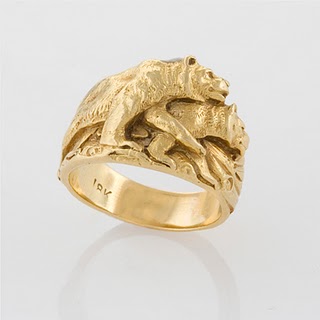
 Bear Ring carved in 18K, c. 1900s 
Attributed to Gustav Manz
Photo Macklowe Gallery


A carved bear and oak leaves surround a star sapphire in this circa 1918 design. The buyer, Robert Hastings, was an associate of Walter P. McTeigue 
Manz ledger, Winterthur Museum Library

Whether Gustav Manz visited the fair as a tourist or worked on jewelry for the exhibits is unknown. He probably profited from the hoopla surrounding the fair through sales of his bear motifs and other "Indian and Aztec" designs advertised in his jeweler's brochure. Buyers for these items included most if not all of the top retailers in New York: in addition to Tiffany & Co, sales are entered in Manz's ledgers for Marcus & Co, Gorham, F. Walter Lawrence, Black Starr & Frost, T. Kirkpatrick, and others. 

Had he decided to make the trek, he might have stayed with his brother-in-law, Carl Bachem; one of the early National Park Service timber inspectors, Bachem lived with his wife Paula in Mill Valley, where many displaced quake victims took refuge. Assured of an expert wilderness guide, Manz's 22-year-old daughter Helen and her cousin Clara boarded the Transcontinental Railroad a few years later for a Grand Tour of the West. The girls brought a camera along and Clara filled an album with snapshots and snappy captions as well as postcards purchased at scenic points along the way. 


No Bear Zone: Helen Manz seated "among the pepper trees" at the base of Mt. Tam with her maternal uncle Carl Bachem, in 1924; a timber expert for the Department of the Interior, Bachem worked with Stephen T. Mather and William Kent during the early years of the National Park Service   

Seeing the entries in Manz's costbooks and the artifacts from Helen's and Clara's trip makes us eager to read a new book about the San Francisco fair: Empire on Display, by art historian Sarah J. Moore, to be published in May 2013. The fellow on the cover appears to be the earliest ticket holder. In fact, he is the exposition's other mascot, Hercules, completing his "13th labor" by muscling through the Culebra Cut (which opened the way for the Panama Canal) for a preview of The Jewel City's glass tower glittering in the distance. 


Book jacket for Empire on Display (2013) based on the official poster
for the 1915 Panama-Pacific Exposition by California artist/lithographer Perham Wilhelm Nahl (1876-1935)  

_________________________________________

Copyright © Laura Mathews, 2014 

All Rights Reserved 
 GUSTAV MANZ LLC
gustavmanz.com
__________________________________________

Special thanks to: 
Research staff at Winterthur Museum Library
A. Richard Boera for preserving scrapbook of his mother's trip west with her cousin Helen

Other helpful sources: 
Bejewelled by Tiffany 1837-1987, edited by Clare Phillips (Yale University Press)
Mount Tamalpais, A History by Lincoln Fairley (Scottwall Associates)
"Sailing to Byzantium: 1915 Panama Pacific International Exposition" by Gray Brechin 
SallyJamesFarnham.org
Sierra Club Bulletin, Vol XI, No 2, January 1921, p. 216

Thursday, February 14, 2013

WHAT'S THE STORY MORNING GLORY?


Design for a pendant or watchcase set with heart-shaped stone and framed by a morning-glory vine  
Gustav Manz, c. 1900
Mathews family collection

For Valentine's Day, two poems celebrating the flower encircling Gustav Manz's heart-shaped pendant...


One morning, Japanese poet Chiyo-ni (1703-75) found her water pail floating in her well, and the rope entwined by morning-glory tendrils. Rather than disturb the plant, she went out and begged water from her neighbors — and composed this charming haiku...


Asago ni

Tsurube torarete

Morai-midzu 

[The morning glory

has seized my well-bucket 

Gift-water]

—Kaga no Chiyo-ni "The Asagao" (Morning-Face)


Gold, platinum,diamond morning glory 
watch pin by Gustav Manz, c. 1900
Mathews family collection  

That I walk up my stoop, I pause to consider if it really be,

A morning-glory at my window satisfies me more than the meta- physics of books.

—Walt Whitman, "Song of Myself" (1881)


Copyright © 2014 All Rights Reserved  GUSTAV MANZ LLC