Showing posts with label Black Starr Frost. Show all posts

Tuesday, February 18, 2014

HORSE SENSE


Illustration from a profile of designer and manufacturing jeweler Gustav Manz ("A Master Sculptor in Precious Metals") featured in Arts and Decoration magazine, January 1926

In the late 19th century, Harlem River Drive was a popular racecourse for horse-drawn carriages. Known as the "Speedway," it ran along the river from 155th Street under the Washington Bridge (not to be confused with the George Washington Bridge, which spans the Hudson and opened in 1931) and up to Dyckman Street.

We don't know whether Gustav Manz, who lived in Washington Heights at that time, was fond of betting. That he was adept at carving equestrian motifs is clear from his business ledgers, which record sales of figural and diamond-studded items to Cartier, Tiffany & Co, Ferdinand Hotz (owner of the Maximilian Diamond), Udall & Ballou, Marcus & Co, Black Starr & Frost, T. B. Starr, Charlton, and Shreve Crump & Low. 


Trotting along the Harlem River, 1903 
Image from NYPL

Lucky horseshoes stickpins and brooches were an Edwardian favorite and turn up in Bailey, Banks & Biddle's ledger books, including one manufactured in 1908 by McTeigue, Manz & Co (Walter P. McTeigue and Gustav Manz). An accompanying sketch indicates 25 stones set in a alternating bands of sapphires and diamonds, evoking racing silks.  

The lilliputian herd on a circa 1900s ring retailed by jeweler F. Walter Lawrence (shown below), evokes Rosa Bonheur's famous painting depicting the horse market in Paris. Manz's close association with Lawrence, and his own reputation as an animalièr who often placed his subjects in leafy surrounds, points to him as the likely carver. 


Inspired by Rosa Bonheur's painting "The Horse Fair," this gold ring set with green tourmaline retailed by jewelry merchant F. Walter Lawrence, here attributed to designer-goldsmith Gustav Manz
Photo from The Keystone, July 1905, p 1073

Completed in 1855, Bonheur's scene of muscular Percherons barely restrained by their trainers as they circle a plaza was already famous by the time Cornelius Vanderbilt acquired the artwork in 1887 from department store magnate Alexander Turney Stewart and gave it to the Metropolitan Museum the following day. When the Met first opened its doors to the public on Sundays in 1891, the gigantic (8 x 16 1/2 foot!!) painting attracted tens of thousands of visitors. 

The miniature frieze of stallions on the "Horse Fair" ring surely created a minor sensation when a photo of it ran in The Keystone in July 1905, shortly after the opening of Belmont Park. Another equine ring sold to Lawrence, depicting horse and trainer, is recorded Manz's cost book records in summer 1910. Due to anti-gambling legislation targeting horse racing, Belmont and other New York tracks closed that season. Perhaps, that season, Lawrence's customer wore it to Ascot or Longchamp.


Entry in Manz's costbook for a gold and lapis seal ring with "Horse & trainer group" carved on the mounting, sold to F.W. Lawrence on June 2, 1910 
Courtesy Winterthur Museum Library


Copyright © 2014 

All Rights Reserved 
 GUSTAV MANZ LLC

Sunday, February 17, 2013

BEAR IN MIND


Gustav Manz sketch for a polar bear scarfpin in 14K gold    
Sold to Mrs. S.J. Farnham (Sally James Farnham) on December 26, 1914 
Archived at Winterthur Museum Library

The day after Christmas 1914, artist Sally James Farnham purchased a small piece of jewelry from the studio of Gustav Manz: a scarfpin in the shape of a polar bear, nose held high. She may have thought of it for a gift, or to wear during opening ceremonies at the Panama-Pacific International Exposition in San Francisco where one of her bronzes—Cave Woman—would soon be on view at the Palace of Fine Arts. The golden California bear was a visual mascot for the fair, appearing on souvenir postcards, fobs, and other merchandise.


"Bear in Mind 1915" 
Collection Burton Benedict 
 bearflatmuseum.org


This postcard for the California Insurance Company reminded tourists of the trauma behind the jubilance of the Exposition's host city 
Collection Carol Brockfield  

San Francisco had edged out New Orleans and Washington, D.C. in the competition to host the fair, and with the worrisome conflict unfolding in Europe, travel agents were busy booking their patrons for trips in the opposite direction. Rebuilding in the city after the great quake had progressed so rapidly that the fair became, in one historian's words, "a festival of self-congratulation and advertisement" encompassing such novelties as the bohemian-glass-clad Tower of Jewels and coffee brewed from beans shipped direct from South America via the Panama Canal. Ascending Mt. Tamalpais in a dinky railway car to see the redwoods and take in the view at the summit was all the rage; the year of the Exposition, 700 passengers road the train up the mountain daily.  


Vintage postcard image of the Tower of Jewels at the 1915 Panama-Pacific International Exposition. The tower was clad in Novagems, free-swinging bits of cut glass that made the building shimmer madly 

On February 20, President Wilson officially opened the exposition via wireless from the White House; the fair quickly broke all attendance records. Tiffany & Co. (where Sally's former husband, Paulding Farnham, had produced many of the firm's show-stopping jewelry designs) was represented by Louis Comfort Tiffany's Favrile glass vessels and a small exhibit in gold, enamel and precious stones. (A pendant necklace attributed to LCT and signed Tiffany & Co, and marked for the Panama-Pacific International Exposition, fetched $182,000 at Christie's Magnificent Jewels sale in April 2011.) 


Gustav Manz sketch for a bear pin in platinum with diamond accents 
Sold to Tiffany & Co in 1910 
Archived at Winterthur Museum Library


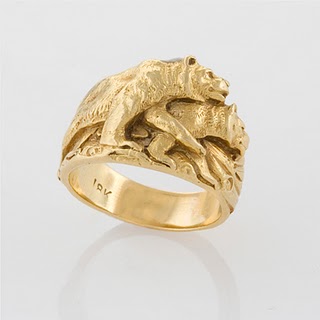
 Bear Ring carved in 18K, c. 1900s 
Attributed to Gustav Manz
Photo Macklowe Gallery


A carved bear and oak leaves surround a star sapphire in this circa 1918 design. The buyer, Robert Hastings, was an associate of Walter P. McTeigue 
Manz ledger, Winterthur Museum Library

Whether Gustav Manz visited the fair as a tourist or worked on jewelry for the exhibits is unknown. He probably profited from the hoopla surrounding the fair through sales of his bear motifs and other "Indian and Aztec" designs advertised in his jeweler's brochure. Buyers for these items included most if not all of the top retailers in New York: in addition to Tiffany & Co, sales are entered in Manz's ledgers for Marcus & Co, Gorham, F. Walter Lawrence, Black Starr & Frost, T. Kirkpatrick, and others. 

Had he decided to make the trek, he might have stayed with his brother-in-law, Carl Bachem; one of the early National Park Service timber inspectors, Bachem lived with his wife Paula in Mill Valley, where many displaced quake victims took refuge. Assured of an expert wilderness guide, Manz's 22-year-old daughter Helen and her cousin Clara boarded the Transcontinental Railroad a few years later for a Grand Tour of the West. The girls brought a camera along and Clara filled an album with snapshots and snappy captions as well as postcards purchased at scenic points along the way. 


No Bear Zone: Helen Manz seated "among the pepper trees" at the base of Mt. Tam with her maternal uncle Carl Bachem, in 1924; a timber expert for the Department of the Interior, Bachem worked with Stephen T. Mather and William Kent during the early years of the National Park Service   

Seeing the entries in Manz's costbooks and the artifacts from Helen's and Clara's trip makes us eager to read a new book about the San Francisco fair: Empire on Display, by art historian Sarah J. Moore, to be published in May 2013. The fellow on the cover appears to be the earliest ticket holder. In fact, he is the exposition's other mascot, Hercules, completing his "13th labor" by muscling through the Culebra Cut (which opened the way for the Panama Canal) for a preview of The Jewel City's glass tower glittering in the distance. 


Book jacket for Empire on Display (2013) based on the official poster
for the 1915 Panama-Pacific Exposition by California artist/lithographer Perham Wilhelm Nahl (1876-1935)  

_________________________________________

Copyright © Laura Mathews, 2014 

All Rights Reserved 
 GUSTAV MANZ LLC
gustavmanz.com
__________________________________________

Special thanks to: 
Research staff at Winterthur Museum Library
A. Richard Boera for preserving scrapbook of his mother's trip west with her cousin Helen

Other helpful sources: 
Bejewelled by Tiffany 1837-1987, edited by Clare Phillips (Yale University Press)
Mount Tamalpais, A History by Lincoln Fairley (Scottwall Associates)
"Sailing to Byzantium: 1915 Panama Pacific International Exposition" by Gray Brechin 
SallyJamesFarnham.org
Sierra Club Bulletin, Vol XI, No 2, January 1921, p. 216