Showing posts with label Paulding Farnham. Show all posts

Saturday, November 23, 2013

MAKING WAVES


Mermaids floating in a lily pond, showing their soon-to-be human knees in Gustav Manz's sterling handbag handle for F. Walter Lawrence, Inc. Photo at top taken in Manz's studio, circa 1903; detail of handle, above, showing clasp set with cushion cut chrysoprase.  

Gustav Manz was present, in spirit and in sterling silver, at the opening for "Gilded New York" at the Museum of the City of New York. We gulped champagne in the elevator on the way up to the Tiffany Foundation room, where Manz's repousse mermaid evening bag frame anchored one of the display cases. 


House rules forbade our toasting this milestone on horseback, a la C.K.G. Billings' equestrian supper at Sherry's, but the opportunity to ogle Worth gowns worn by the apparently lilliputian wives of those same industrialists, while standing nose to nose with a brace of Tiffany sirens holding up a tureen-sized 1889 Goelet racing cup, was ample compensation.


Pausing to admire the portrait of willowy, swan-necked Eleanor Iselin Kane (Mrs. Delancey Astor Kane), with decorative frame by Stanford White, we had a vision of Manz's sirens surfacing in a headline in William d'Alton Mann's Belle Epoque scandal sheet Town Topics: MAIDEN LANE MERMAIDS CRASH MUSEUM MILE!


The show, beautifully organized by curators Jeannine Falino, Donald Albrecht, and Phyllis Magidson will be up through November of next year. An added attraction for visitors is heirloom spotting on the perimeter of the museum, located at Fifth Avenue and 103rd Street. An actual Paulding Farnham iris brooch, not part of the exhibit but of the same era, flared its nostrils from the shoulder ahead of us at the coat-check. 

"I outbid Tiffany," its current owner replied after we complimented. We didn't doubt her. 


Images from top: Mermaid purse frame, Janet Zapata Collection. Mermaid photos Winterthur Library, Joseph Downs Collection and Magazine Antiques; Goelet cup, MCNY; portrait of Mrs. Delancey Astor Kane, Museum of the City of New York; Iris brooch by Paulding Farnham, Primavera Gallery


__________________________________________

Copyright © Laura Mathews 

All Rights Reserved 
 GUSTAV MANZ LLC
__________________________________________

Sunday, February 17, 2013

BEAR IN MIND


Gustav Manz sketch for a polar bear scarfpin in 14K gold    
Sold to Mrs. S.J. Farnham (Sally James Farnham) on December 26, 1914 
Archived at Winterthur Museum Library

The day after Christmas 1914, artist Sally James Farnham purchased a small piece of jewelry from the studio of Gustav Manz: a scarfpin in the shape of a polar bear, nose held high. She may have thought of it for a gift, or to wear during opening ceremonies at the Panama-Pacific International Exposition in San Francisco where one of her bronzes—Cave Woman—would soon be on view at the Palace of Fine Arts. The golden California bear was a visual mascot for the fair, appearing on souvenir postcards, fobs, and other merchandise.


"Bear in Mind 1915" 
Collection Burton Benedict 
 bearflatmuseum.org


This postcard for the California Insurance Company reminded tourists of the trauma behind the jubilance of the Exposition's host city 
Collection Carol Brockfield  

San Francisco had edged out New Orleans and Washington, D.C. in the competition to host the fair, and with the worrisome conflict unfolding in Europe, travel agents were busy booking their patrons for trips in the opposite direction. Rebuilding in the city after the great quake had progressed so rapidly that the fair became, in one historian's words, "a festival of self-congratulation and advertisement" encompassing such novelties as the bohemian-glass-clad Tower of Jewels and coffee brewed from beans shipped direct from South America via the Panama Canal. Ascending Mt. Tamalpais in a dinky railway car to see the redwoods and take in the view at the summit was all the rage; the year of the Exposition, 700 passengers road the train up the mountain daily.  


Vintage postcard image of the Tower of Jewels at the 1915 Panama-Pacific International Exposition. The tower was clad in Novagems, free-swinging bits of cut glass that made the building shimmer madly 

On February 20, President Wilson officially opened the exposition via wireless from the White House; the fair quickly broke all attendance records. Tiffany & Co. (where Sally's former husband, Paulding Farnham, had produced many of the firm's show-stopping jewelry designs) was represented by Louis Comfort Tiffany's Favrile glass vessels and a small exhibit in gold, enamel and precious stones. (A pendant necklace attributed to LCT and signed Tiffany & Co, and marked for the Panama-Pacific International Exposition, fetched $182,000 at Christie's Magnificent Jewels sale in April 2011.) 


Gustav Manz sketch for a bear pin in platinum with diamond accents 
Sold to Tiffany & Co in 1910 
Archived at Winterthur Museum Library


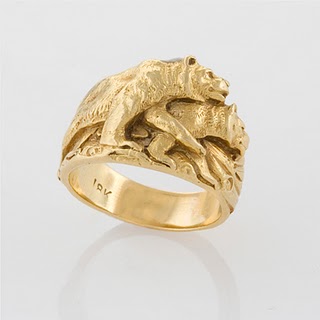
 Bear Ring carved in 18K, c. 1900s 
Attributed to Gustav Manz
Photo Macklowe Gallery


A carved bear and oak leaves surround a star sapphire in this circa 1918 design. The buyer, Robert Hastings, was an associate of Walter P. McTeigue 
Manz ledger, Winterthur Museum Library

Whether Gustav Manz visited the fair as a tourist or worked on jewelry for the exhibits is unknown. He probably profited from the hoopla surrounding the fair through sales of his bear motifs and other "Indian and Aztec" designs advertised in his jeweler's brochure. Buyers for these items included most if not all of the top retailers in New York: in addition to Tiffany & Co, sales are entered in Manz's ledgers for Marcus & Co, Gorham, F. Walter Lawrence, Black Starr & Frost, T. Kirkpatrick, and others. 

Had he decided to make the trek, he might have stayed with his brother-in-law, Carl Bachem; one of the early National Park Service timber inspectors, Bachem lived with his wife Paula in Mill Valley, where many displaced quake victims took refuge. Assured of an expert wilderness guide, Manz's 22-year-old daughter Helen and her cousin Clara boarded the Transcontinental Railroad a few years later for a Grand Tour of the West. The girls brought a camera along and Clara filled an album with snapshots and snappy captions as well as postcards purchased at scenic points along the way. 


No Bear Zone: Helen Manz seated "among the pepper trees" at the base of Mt. Tam with her maternal uncle Carl Bachem, in 1924; a timber expert for the Department of the Interior, Bachem worked with Stephen T. Mather and William Kent during the early years of the National Park Service   

Seeing the entries in Manz's costbooks and the artifacts from Helen's and Clara's trip makes us eager to read a new book about the San Francisco fair: Empire on Display, by art historian Sarah J. Moore, to be published in May 2013. The fellow on the cover appears to be the earliest ticket holder. In fact, he is the exposition's other mascot, Hercules, completing his "13th labor" by muscling through the Culebra Cut (which opened the way for the Panama Canal) for a preview of The Jewel City's glass tower glittering in the distance. 


Book jacket for Empire on Display (2013) based on the official poster
for the 1915 Panama-Pacific Exposition by California artist/lithographer Perham Wilhelm Nahl (1876-1935)  

_________________________________________

Copyright © Laura Mathews, 2014 

All Rights Reserved 
 GUSTAV MANZ LLC
gustavmanz.com
__________________________________________

Special thanks to: 
Research staff at Winterthur Museum Library
A. Richard Boera for preserving scrapbook of his mother's trip west with her cousin Helen

Other helpful sources: 
Bejewelled by Tiffany 1837-1987, edited by Clare Phillips (Yale University Press)
Mount Tamalpais, A History by Lincoln Fairley (Scottwall Associates)
"Sailing to Byzantium: 1915 Panama Pacific International Exposition" by Gray Brechin 
SallyJamesFarnham.org
Sierra Club Bulletin, Vol XI, No 2, January 1921, p. 216

Tuesday, January 24, 2012

AMERICAN BEAUTIES


Sally James Farnham posed in front of a Peacock Screen, circa 1906, for this portrait by her cousin Charles Chapman, a Manz neighbor in the Leonia, New Jersey artists colony. Image courtesy Michael Reed, sallyjamesfarnham.org


Gustav Manz's jewelry log records sale of a Zodiac Band Ring to "Mrs. Farnham" in 1916. Sally James Farnham had recently separated from husband Paulding Farnham, whose neoclassical jewelry and metalwork designs for Tiffany & Co won the firm accolades at many international exhibitions.  Farnham was undoubtedly aware of Manz's jewelry as his workshop supplied Tiffany and other fine jewelers around town. Gustav and Sally were both animalier sculptors, so there was a personal as well as professional acquaintance. 


Ink on parchment sketch for a zodiac ring 
Gustav Manz ledger, circa 1916-1917
Image (c) Gustav Manz LLC


The Zodiac ring echoed the fancy cigarette case Farnham had presented to her husband for his 42nd birthday in November 1901; the couple shared the same birth month (Sally's birthday fell on November 26), and the case incorporated both the Farnham crest carved into a cabochon sapphire centered on one side paired with a beautifully modeled Centaur aiming his bow and arrow on the other—an allusion to Sally's astrological sign and passion for horses. 


Gold, silver, sapphire cigarette case inscribed "Paulding Farnham New York from S.J.F., Nov. 6, 1901. Interior marked Tiffany & Co. Image Sotheby''s


A few years after receiving the cigarette case, Paulding Farnham resigned from Tiffany & Co, and moved out west, where he mounted a second career as a maritime painter and made unlucky investments in mining. Left with three children to support, Sally filed for divorce on grounds of abandonment (granted in 1915), and stepped up her productivity—helped along by good connections (Frederic Remington was a mentor), and public interest in the the novelty of a socially prominent mother of three getting her hands into clay and plaster. As the Gilded Age waned, the Sculptress got busy.

The year 1916 began inauspiciously when the statue she'd proposed for a public garden in Philadelphia, depicting astronomer and inventor David Rittenhouse, was cancelled due to the death of the monument's primary financial backer. Her big break came in August 1916, when she won a $24,000 commission to create a monument to Simon Bolivar. Her scheme for a statue of the liberator of the Spanish colonies dressed in full military regalia, astride a horse lifting its hoof, beat out a field of 20 artists. 


Perhaps the Manz Zodiac ring was a gift to herself in her 46th year.


She's got the horse right here: Farnham stands under Bolivar statue
 in a borrowed studio. The sculpture currently stands sentry near Artists' Gate in Central Park at 59th Street and Avenue of the Americas
Image: Smithsonian Institution, Peter A. Juley & Son Collection


As the Bolivar monument was unveiled, art critic Alexander Woollcott enthused that the work was "the [largest] by a woman which history anywhere records"; more noteworthy was Farnham's lack of experience, in comparison with the other entrants: "The great Bolivar is the work of an unschooled, self-taught artist who never had a lesson in her life and, what is more, it is the work of one who was a grown woman, the mother of two children, before she did her first modeling; indeed before the idea of being a sculptor at all ever entered her much-preoccupied head..." (More on Sally's career at Smithsonian blog.) 

Farnham and Woollcott were chummy with another prominent female artist of the 1920s, Neysa McMein, whose pastel portraits of modern American girls were in demand for magazine covers and advertising campaigns. Perhaps it was Farnham who suggested Gustav's daughter Doris pose for one of McMein's covers for McCall's famous series capturing the diverse "types" of American beauty (a pseudo-ethnographic campaign sparked, no doubt, by the resurgence of eugenics movements following the first world war). McMein cast (or miscast) fair-haired Doris, child of German immigrant parents from the Black Forest region, as "The Scandinavian Beauty."


Neysa McMein finishing a  cover illustration for McCall's magazine. In 1936, McMein designed the first official image of Betty Crocker.
Photo: Grapefruit Moon Gallery 


Doris had entered the family business at age 17 or younger, initially as sales rep for her father then as a diamond broker selling stones to Cartier, young Harry Winston, and Black Starr & Frost. Ggrowing up in Leonia, New Jersey, she'd posed for Sally Farnham's cousin, the artst Charles Shepard Chapman—a Manz neighbor and co-founder of the Leonia School of Illustration. McMein's portrait captures Doris as she must have looked seated on a train bound for Chicago or Hot Springs or Palm Beach, carrying a suitcase of her father's jewelry samples, her own business card, and a snappy sales pitch. Hoping, perhaps, that on the way she'd meet a dashing Centaur of her own.


At 20, Manz's younger daughter, Doris, posed for Neysa McMein's "American Beauty" series. Her portrait appeared on the November 1924 cover


_________________________________________

Copyright © 2014

All Rights Reserved 
 GUSTAV MANZ LLC
__________________________________________

Our thanks as always to Kay Olson Freeman for insights about Farnham's work and to Michael Reed, director of the Sally James Farnham website, for sharing sketches possibly related to Farnham's submission to the Philadelphia public monument competition.