Friday, January 11, 2013

WE BRAKE FOR GRIFFINS


Above: design for double griffin mounting by Gustav Manz late 1900; below: art deco diamond bracelet retailed by T. Kirkpatrick & Co, circa 1925, attributed to Gustav Manz


In Grimms' tale "Der Vogel Greif" (1814), a King demands that a peasant lad seeking the hand of his daughter must first bring him a feather from the tail of a griffin. Find a griffin in the Black Forest?  No problem: "Hans set out at once, and walked straight forwards..." 

Outside fairy tales and the shields of the Grand Dukes of Baden, though, whence came the griffin? According to Stanford folklorist Adrienne Mayor, the scrambled body parts of a classical griffin—a lion's body with the beak and wings of an eagle—may have been based on nomads' observations of dinosaur skeletons in the deserts of Central Asia. 


"Der Vogel Greif"
Woodcut from 1890s edition of Grimms' fairy tales 
compiled by Phillip Grot Johann and R. Leinweber 
Image Michael Studt @ Flickr


Brooch marked "T.B. Starr" for Theodore B. Starr 
(Nelson Rarities)

      
Modern interpretation of "Schlieessen" (striped griffins) by Otto Jakob, circa 1990s 

The mythological griffin has long charmed jewelers and goldsmiths: Griffins, after all, guard their precious hoard by gripping them in their beaks or talons or tucked into nests with their young. During the Beaux Art period (1880s-1920s), Gustav Manz fabricated griffin fobs, pendants, and rings for his wholesale clients. A pair of hand-drawn heraldic griffins—one holding a torch, the other a shield—flank mounting samples on a circa 1910 Manz sales brochure. His workshop manufactured a line of "Heraldic" gems, reflecting the era's appetite for neo-Tudor architecture and interiors. Manz's griffin designs were carried by Gorham Co., T. Kirkpatrick & Co, Mount & Woodhull, Chicago gem dealer Ferdinand Hotz, and others.   


Gold, diamond, and ruby ring by Gustav Manz, circa 1910 (family collection); Manz design for a gryphon ring with collet set gem

Manz's hand-carved mountings appealed to Detroit gem dealer W. A. (William Alfred) Sturgeon, who purchased one of the jeweler's signature griffin rings during a buying trip in November 1909. Sturgeon had learned his business at the old Detroit concern M. S. Smith & Co (later F.G. Smith, Sons & Co), starting in 1878 at age 15, and remained there until April, 1891, when he and another local diamond salesman, Charles Woodbury Warren, formed a partnership. 


Manz stockbook entry for carved griffin ring 
sold to W.A. Sturgeon, 1909 
Winterthur Museum Library

Warren (b. Portland, Maine, 1861) got his start at George W. Smith & Co. in Philadelphia, moved to Mermod & Jaccard in St. Louis, and then to the diamond department of Wright, Kay & Co. in Detroit. They were joined by Ralph Dewey, who'd worked his way up from messenger boy for M.S. Smith, and in later years would open Spaulding & Company's Paris store before returning to Detroit to start his own company, with branches in New York and Paris. 


Gilded Age diamond merchants 
Charles Warren and William Sturgeon
Source: Detroit in History and Commerce, 1891

The "Aladdin-like" parlors of Sturgeon & Warren, located at 17 State Street, were decorated to evoke Parisian salons de bijoux.  The partnership was relatively short-lived, as Warren soon left to start Charles W. Warren & Co., while Sturgeon continued with other partners, under the name Smith, Sturgeon & Co. and W.A. Sturgeon & Co at 237-241 Woodward Avenue (a few doors from Traub Bros., Detroit's oldest jewelry firm, est. in 1850 as Duncan and Traub).


Heraldic griffin adorning Manz sales brochure, undated


Bronze griffins guard an arcade near Madison Square 
Park in midtown Manhattan, a short distance from 
Gustav Manz's workshop at 37 East 28th

By 1911, Sturgeon, had shifted gears and gone horseless, joining Henry L. Walker, Jr., founder of one of Detroit's early electric automobile  companies. Walker's father owned the Detroit Free Press and was prominent in Michigan politics, having served as attorney general and postmaster of Detroit. The November 19, 1913 edition of The Horseless Age informed the trade that W.A. Sturgeon was managing the "exclusive garage and showroom" for the Woods electric car dealership at 703 Woodard Ave. When customers arrived to test-drive a roadster, the hand reaching out to shake on the deal may well have been wearing a custom-built 18K gold Gustav Manz griffin ring.


Griffins of Motor City: The hood of a 1930s Essex Terraplane, guarded by a chrome deco-style griffin; below, griffin relief carved by architectural sculptor Corrado Parducci in the 1930s stands sentry at the entrance to Luther Burbank School in Detroit 
(image via pinehurst19475 flickr)


_________________________________________

Copyright © 2014 

All Rights Reserved 
 GUSTAV MANZ LLC
__________________________________________

Sources
Detroit in History and Commerce, Rogers & Thorpe, 1891
The Book of Detroiters, Albert Nelson Marquis, 1914
The Horseless Age: The Automobile Trade Magazine, Vol 32, No. 21, p. 864


updated 9/26/13

Thursday, November 29, 2012

SCARAB FEVER


Sphinx head incorporating a piece of ancient glass, design modeled in wax and cast in gold by Gustav Manz for F. Walter Lawrence (image Town & Country, December 12, 1903)

In late spring 1904, Jewelers' Circular reviewed an exhibit organized by the Handicraft League of Cincinnati and held at the city's Woman's Club, leading with a case with almost 50 pieces belonging to "Gustav Manz, New York" that included "fine examples of the old Egyptian outline":
  • "The rings in the collection were immense and the settings of gems in etruscan gold, as well as the large brooches of lapis lazuli, Cyprian glass sphynx (sic) head, in the styles of over 2,000 years ago, made a decidedly beautiful and instructive collection..." (1)


Gustav Manz necklace pendant with scarab and pyramid-shaped drop featured at the eighth Industrial Arts Exhibition at the Metropolitan Museum of Art (image from The Jewelers' Circular, January 30, 1924) 

Earlier that spring Manz's historical and nouveau inspired gold-work, including a sphinx head scarf pin fashioned around a piece of ancient glass, filled the case of jeweler F. Walter Lawrence's display at the 1904 World's Fair in St. Louis. Manz's work appeared in articles Lawrence wrote for The Craftsman (2) and Town & Country (3). While neither publication credited Manz as the maker, forms submitted to the jury selecting jewelry for the St. Louis exposition reveal that virtually all of the hand-wrought work in Lawrence's traveling collection were modeled and cast by the German-born Manz, and likely had a hand in designing as well (though an emphasis on "American" design and artistry probably worked against giving credit where it was due). Lawrence's salon, along with most of the prominent jewelry retailers in Manhattan, Boston, Philadelphia and elsewhere, would carry Manz's wares over the next four decades. 


Manz's workshop produced this ring carved with stylized Egyptian lotus and set with green tourmaline for Tiffany & Co, 1922 (Manz archive, Winterthur Museum); below: Manz gouache design for a gem-set pendant with carved urei and Egyptian figure wearing headdress (Mathews Family Collection)


By 1912, after partnering with fellow manufacturing jeweler Walter P. McTeigue for a few years, Manz was established in his own studio-factory on East 28th Street, at the edge of the Flatiron District. In March of that year, he registered copyright on one of his Egyptian designs: a sculpted panel, or plaque, depicting "Two columns, carved with figure of Isis and Osiris, supporting plate above panel of pyramids, sphinx and two lions nearby, in bas-relief." 

As the jewelry industry recovered from World War I, and the 1920s roared in, orders for Manz's patriotic themed subsided and demand for his Egyptian, animal, and "oriental" novelties increased. Around this time Manz's younger daughter became her father's traveling sales representative and in-house advisor on rapidly evolving post-war fashions for women. His long record of supplying fine carved mountings for Tiffany & Company paid off when he was invited to participate in one of the Metropolitan Museum's series of industrial art exhibits organized by the museum's forward-thinking decorative arts curator Richard Bach. 


        Gustav Manz gouache rendering of an Egyptian temple 
            mounting for a scarab (Mathews Family Collection)

The Jewelers' Circular's fashion correspondent Isabelle Archer effused over "splendid examples of commercial jewelry [from] the houses of Mehrlust, Manz, and Cartier..."(4) on view at the eighth annual show. One of the most admired pieces in Manz's case was a pendant depicting a king of the Nile flanked by seated attendants; it appeared on the cover of Jewelers' Circular's issue containing the first of Archer's reviews of the 1924 show. The piece incorporated a pastiche of symbols derived from Manz's earlier studies of archaeological holdings at the Cairo Museum as well as objects from excavations of Tutankhamun's tomb.


Detail from brochure for Metropolitan Museum of Art Eighth Exhibition of Industrial Art, 1924; inset: the Met decorative art galleries, circa 1920s (brochure and gallery image accessed via Thomas Watson Library, MMA)

At the conclusion of her review, Archer pivoted from the angular sapphire, diamond and onyx jewels in the Cartier group to Manz's latest reboot of traditional motifs that were, in her words, "very distinctly the Oriental type." The array of jade, pearls, pink beryls, and other gemstones set in lattice made for "a most remarkable color scheme."(5) Cartier's geometric mounts and Manz's chinoiserie broke away from art nouveau fantasy and Edwardian garlands and toward the sleeker, stylized forms and brilliant colors embraced by the flapper generation and designers of the art deco era. 

Manz's work rarely qualified as trendy, however. To the end of his career he maintained a craftsman's allegiance to hand-wrought, custom work, generally eschewing deco's glossy, machine-age contours. Through all the change he witnessed in over his five decades in America—political, social, industrial—his favorite periods and motifs hardly changed. As Fitzgerald writes at the end of The Great Gatsby, his 1925 flapper novel: "So we beat on, boats against the current, borne back ceaselessly into the past."


From Near to Far East: This gold, jade, and enamel Buddha pendant passed down to a descendant by Manz's daughter may have featured in his display case at the Metropolitan Museum Industrial Art show in 1924 (Mathews family collection)


Notes
(1) "Beautiful Art Work at the Recent Exhibition of the Handicraft League of Cincinnati." The Jewelers' Circular-Weekly, Vol. 53, No. 20 (1904): 14  
(2) Lawrence, F. Walter. "Craftsmanship versus Intrinsic Value." The Craftsman 4:3 (1903): 181-185 (illustrated)
(3) Lawrence, F. Walter. "Symbolism and Jewelry." Town & Country (December 12, 1903): 34-35
(4) Archer, Isabelle M., "When Art Meets Industry: Modern Decorative Design As Shown at The Metropolitan Museum." Archer, Isabelle M. The Jewelers' Circular, Vol. 88 (February 6, 1924): 275. Jacob Mehrlust was the third manufacturer, along with Cartier and Gustav Manz, who received special mention in Archer's review.
(5) Archer, Isabelle M., "The Present Trend in Decorative Designing, Traced Through the Industrial Exhibition Now at the Metropolitan Museum," Jewelers' Circular Vol. 88 (January 30, 1924): 53-55

We would like to thank Courtney Bowers Marhev, author of the first scholarly 
study of Gustav Manz's work, Where Credit Is Due (Smithsonian, 2008); Janet Zapata for identifying Manz's relationship with F. Walter Lawrence in an article for Magazine Antiques (April 2004); the Thomas J. Watson Library at The Metropolitan Museum for digital access to The Jewelers' Circular, Industrial Art exhibition catalogs, and help locating correspondence between 
Doris Manz Eastman and Francis Henry Taylor; and to Winterthur Museum, Garden, 
and Library as the repository for the Gustav Manz Papers.


Post updated October 21, 2019

__________


Copyright © 2019 | All Rights Reserved 
 Except where otherwise credited all images 
 © Gustav Manz LLC


Monday, November 5, 2012

"YOU CAN'T CRY ON A DIAMOND'S SHOULDER" — Elizabeth Taylor


Talk about gem lust. Here's actor Richard Burton licking his chops after a conquest (from his diaries, published this week by Yale University Press):

[November 1969]
Saturday 1st, Gstaad I bought the ring for Elizabeth. I had set a 'lid' on it of one million dollars if thou pleasest and Cartier outbid me by $50,000...bugger Cartiers, I was going to get that diamond if it cost me my life or 2 million dollars whichever was the greater. [The next day Burton negotiated with Cartier to buy the stone.For 24 hours the agony persisted and in the end I won. I got the bloody thing. For $1,100,000...It turns out that one of my rivals was Ari Onassis but he chickened at $700,000. But apart from the fact that I am a natural winner, I wanted that diamond because it is incomparably lovely. And it should be on the loveliest woman in the world. I would have had a fit if it went to Jackie Kennedy or Sophia Loren or Mrs. Huntingdon Misfit of Dallas, Texas....

Postscript: After the couple divorced in 1978, Taylor auctioned the 69.42 carat stone (known as the Taylor-Burton Diamond); Taylor reportedly earmarked the $5 million proceeds from the sale to help build a hospital in Botswana.


Shoulder to shoulder: Richard and Elizabeth
 17 November 1969
(Courtesy Yale University Press)

_________________________________________

Copyright © Laura Mathews, 2014 

All Rights Reserved 
 GUSTAV MANZ LLC
__________________________________________

Sunday, November 4, 2012

CARRYING THE FLAG FOR TUSK


Explorers Club flag designed by founding member
Frederick S. Dellenbaugh 

Superstorm Sandy forced Tusk USA to shift venue for its inaugural Friends of Tusk fundraising gala from flooded Tribeca to higher ground. On very short notice, the Explorers Club opened its doors for a reception at which guests heard Bryan Christy, author of the recent National Geographic cover story "Blood Ivory," spoke about his investigation of global markets for decorative and religious carved ivory that help drive illegal trafficking. John Heminway presented a clip from his documentary "Battle for the Elephants." 

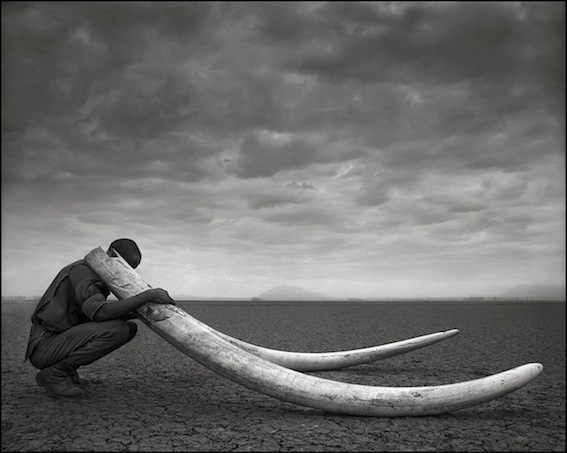
An art sale at the event, which raised in excess of $200,000 to support Tusk's programs, featured Nick Brandt's photograph "Ranger with Tusks of Killed Elephant"; a sculpture of a lion by British artist Tatyana Murray; and a Gustav Manz sterling cuff—donated in support of Tusk's 3650 Campaign. 


Elephant mother and calves 
Photo (c) by Nick Brandt


Copyright © Laura Mathews
All Rights Reserved 
 GUSTAV MANZ LLC

Tuesday, October 16, 2012

A NIGHT FOR THE ELEPHANTS

On Thursday, November 1, Tusk USA will hold its inaugural fundraising dinner in New York City. Take the night off and meet some artists and writers who are passionate about protecting Africa's wildlife. Hope we'll see you there!


Friends of Tusk USA Dinner

When          1st November 2012
Where         NEW! Explorers Club, New York
Tickets        Please enquire about tickets at winsor@tusk.org 
Gallery sales will include a selection of other works by Nick Brandt, as well as  Anna Trzebinski's beautifully designed pashminas, a specially designed sculpture by British artist Tatyana Murray and a hand-made, limited edition Gustav Manz elephant cuff bracelet sold exclusively for Tusk. Raffle tickets are on sale now at Eventbrite — win a luxury safari kindly donated by Cazenove + Loyd.  
To book tickets please visit: 
http://friendsoftuskusa.eventbrite.com


All proceeds from the sale of the Elephant Bracelet on the night of the event will be donated to support the work of Tusk

_________________________________________

Copyright © Laura Mathews, 2014 

All Rights Reserved 
 GUSTAV MANZ LLC
__________________________________________

Monday, October 1, 2012

BOW WOW WOW


Bronze medal carved by Gustav Manz, circa 1905
Jay Heritage Center Van Norden Collection


The handsome mug in the pic above lives at the Jay Heritage Center, a gift from a member of the Van Norden family, who owned the mansion prior to its becoming a museum. The signature of the artist, Gustav Manz, can be spotted just above the second "A" in "America." The Van Nordens bred many champion dogs as well as livestock at their estate in Rye, New York—from Frenchies shown at the 1900 Paris Exposition, to Highland cattle brought to the 1904 World's Fair in St. Louis. 

Numerous canines and felines passed through the Manz household in Leonia, New Jersey in the 1900s (none of them show animals, although on occasion he was said to have smuggled home a wildcat or panther cub borrowed from the Bronx Zoo to sketch). The artist's grandson recalls that Manz was partial to St. Bernards, perhaps reflecting his Swiss-German roots. 


Manz design for French Bull Dog scarfpin
from a circa 1910 sales brochure
  Mathews Family Collection

Known for his animal miniatures, Manz  designed mountings for Marcus & Co, Tiffany, T. Kirkpatrick & Son, Black Starr & Frost and other merchants who catered to the dog fanciers parading their pooches around the Hotel Astor. His arrival in New York in the 1890s more or less coincided with the Frenchie's rising profile at kennel club shows. (Early skirmishes with aficionados of the rose-eared bulldog—preferred by English breeders—spurred the formation of the French Bull Dog Club of America; the bat-ear soon came to be favored by show judges.) 


Top: Manz's rendering for circa 1910 diamond-pave English pug or bulldog scarfpin,Mathews Family Collection; Ledger entry for a gold scarf-pin by Manz sold to Tiffany & Co, circa 1910; Joseph Downs Collection, Winterthur Museum


Sometime after the club's inaugural meeting on February 12, 1898, a commission for a special bronze medal carved by Manz was arranged by jeweler F. Walter Lawrence (whose stamp appears on the rim). An avid golfer and founding member of the Canoebrook Country Club near his home in Summit, New Jersey, Lawrence had grown up in Maryland and was plugged into the sporty set. 

Manz, by contrast, entered the trade at 14 as a goldsmith's apprentice in Germany, then worked in shops across Europe before taking a year to prospect in Africa's diamond fields and sketch the wild animals he would later carve in bronze, gold, and platinum. His medal must have been well received: it appeared on the cover of the Westminster Show edition of the French Bull Dog Club's magazine in January 1913. 

That same year Cole Porter—a junior at Yale—penned his famous fight song enshrining the school mascot: a bulldog named Handsome Dan. English not French, but vive la difference!


Bow-wow-wow: Cole Porter's sheet music 
for his alma mater's most popular fight song


__________________________________________________________________
We welcome all comments, and invite you to follow Gustav Manz on Facebook and Instagram

Copyright © 2014 All Rights Reserved 
Gustav Manz LLC